Showing posts with label glamour nice bikes. Show all posts

Sunday, July 3, 2011

Motorcycle Racing: Then and now...

Motorcycle Racing: Then and now...

I don’t need Mahabaleshwar or Lonavala on weekends – MotoGP on television, a bunch of friends who’re also mad about motorcycle racing and some cans of cold beer work just fine. And while everyone is rooting for Rossi, I’m usually harbouring secret hopes of Loris Capirossi (and till last year, Max Biaggi…) pulling one out of the bag and taking top spot.

Rossi is a racing god no doubt, but my loyalties are elsewhere. Cable TV has been around for less than twenty years and hence most of my motorcycle racing heroes, and the racing motorcycles which I idolise, are from the 1980s and 90s, which is when I started watching racing regularly. Barry Sheene, Eddie Lawson, Wayne Gardner, Wayne Rainey, Kevin Schwantz and Mick Doohan from the two-stroke 500s era. Biaggi, when he was racing Aprilia 250s, was awesome. Capirossi’s 125 and 250 battles were also epic. From World Superbikes, some names that come to mind are Giancarlo ‘The Lion’ Falappa, Raymond Roche, Fabrizio Pirovano, Doug Chandler, Rob Phillis, Scott Russell, Doug Polen and of course, Carl Fogarty.

It’s not that motorcycle racing is any less exciting now than it was in the 80s and the 90s. It’s just that motorcycle racing heroes you grow up watching and reading about, like the music you grow up listening to, always stay with you. They are special in ways that can’t always be logically explained. Kevin Schwantz, for example, may have won only one 500cc World Championship, but for me, he’ll always be greater than Valentino Rossi. A part of the all-American Rainey-Lawson-Schwantz holy trinity, number 34 is magical beyond the number of races and championships won.

Likewise, I worship Freddie Spencer for having won both the 250 and the 500 crowns in 1985. And Lawson, for winning the 500cc championship aboard a Yamaha YZR500 in 1988 and then again winning the 500 crown in 1989, on a Honda NSR500. That both machines were radically different in terms of their power delivery and handling characteristics made Lawson’s victories that much more significant. Of course, Lawson also gave Cagiva their first 500cc GP win in 1992, in the Hungarian GP, and got a Ferrari from Claudio Castiglioni for his efforts! And I do think Lawson’s fire-engine red Cagiva was one of the best-looking racing bikes ever, along with Schwantz’s 1989 Pepsi Suzuki RGV500, various Rothmans Honda NSR500s and green-white-blue Kawasaki ZXR750s from world superbikes. The JPS-liveried Norton F1 rotary racers also have a special place in my memories, as does the extraordinary blue-and-pink Britten V1000, which used to leave Ducati V-twins like they were standing still.

From ferocious, fire-spitting, two-stroke 500s, to tech-laden 990cc four-stroke MotoGP bikes today, and 800cc machines which are going to come in from next year – change has been the only constant in top-flight motorcycle racing. However, one thing still hasn’t changed. What’s still as important today as it was back then is what the oft-injured Barry Sheene used to say. It’s the will to win. And that, thankfully, will never change…

Motociclo Bello!

I often wonder what it is about Italy. It’s a small little country, and unlike Japan or Germany, it’s not generally regarded as being particularly advanced in… well, anything. With one exception though. Italian motorcycles. And cars for that matter. Some of the most exquisitely beautiful motorcycles available today are from Italy. Which is delightfully surprising, because none of its neighbouring countries is anywhere near Italy in terms of motorcycle building abilities. French motorcycles? When was the last time you heard of a Voxan? Germany? Except for the BMW K1200R and the R1200GS, I can’t think of a single German motorcycle that I’d want to have anything to do with. Austria? The KTM 990 Super Duke is interesting, but apart from that, absolutely nothing. And it’s the same story with Switzerland, Greece, Hungary, Algeria, Bulgaria, Croatia, and… I can’t think of any other countries in that neighbourhood. Motorcycles from these European countries? Zero, zilch.

While the Japanese are certainly making some of the most powerful, quickest, fastest, and fun to ride motorcycles (which are also very reliable and affordable…), the Italians have taken the art of making motorcycles to another level altogether. The engine performance may be just about equal to, and in many cases below that of similar-spec Japanese bikes, but when it comes to styling, the Italians are Gods. Take one look at the MV Agusta F4 and tell me if you think its lines can ever be improved upon. The F4 750 was launched in 1997, and ten years on, it’s still the best looking motorcycle in the whole world. And the other MV, the Brutale 910 isn’t too far behind either.

The man who designed the F4, Massimo Tamburini, also designed one more motorcycle which the world will never forget – the Ducati 916. While Ducati have, since then, moved to the 999, the new bike certainly isn’t as svelte and sexy-looking as the old 916. Which is understandable perhaps. Tamburini is Italian. Pierre Terblanche, who designed the 999, hails from South Africa. At least the Ducati Monster, especially the S4R, continues to look good as ever. The new Ducati Sport Classics have more style, more beauty than the best Milan fashion houses put together, and the Paul Smart replica is to die for.

Though I rate the Bimota Mantra as one of the ugliest bikes ever made (but then it was designed by Sacha Lakic, a Frenchman, not Italian…), I have been a big fan of other Bimotas. The SB6 and the YB11 was really good looking, and the even more gorgeous Furano, fuel-injected and packing 164 horsepower, was, for some time in the mid-1990s, the fastest production motorcycle in the world. And what motorcycle enthusiast can ever forget the hub-centre-steered Bimota Tesi 1D, so radical, so beautifully engineered and so deserving of success? What a pity then that Bimota have never really managed to earn enough money for proper, full-scale R&D operations. Still, the new Bimota DB5 and the Delirio are some of the most sumptuous motorcycles produced anywhere.

And the list doesn’t end with MV Agusta, Ducati and Bimota. There’s also Aprilia with the very beautiful and aggressive RSV 1000R and the slightly insane Tuono. There’s Moto Morini, with their mind-blowing Corsaro 1200. And there’s Benelli and Laverda and Moto Guzzi, whose long-departed Sei 900, Jota and Le Mans 850 are still remembered with so much fondness, by fans of Italian motorcycles. No doubt, Italian motorcycles have always been special in ways that cannot be explained by real-world logic. Let’s hope they stay that way.

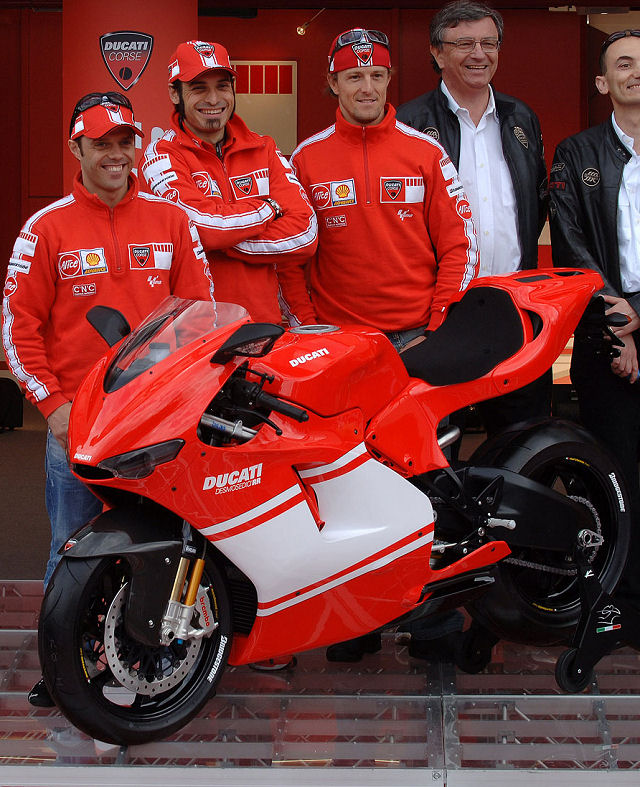
Ducati Desmosedici RR: Whatever next?!

Ducati had announced their intent during the World Ducati Week, back in May 2004. And today, in June 2006, they’ve kept their word. 989cc L4. 205 horsepower. About 165 kilos dry weight. And a top speed in excess of 320km/h. Ducati’s Desmosedici RR, the world’s first road-legal MotoGP replica is go. Okay, so the road going Desmosedici RR has about 35 horsepower less than the bike which Loris Capirossi rode to victory in this year’s MotoGP at Jerez. And Ducati are only building 400 of these bikes, of which more than 300 are already spoken for. Plus, each RR will cost in about US$65,000 so it’s not like you can just rush to the nearest Ducati dealership and put down a deposit on one. But yes, if there’s one thing in the world which makes me want to earn more money, it’s this Ducati. It’s gorgeous beyond its sand-cast aluminium alloy crankcase and cylinder heads. It’s glorious beyond its titanium con-rods and valves. It’s desirable beyond its magnesium engine covers…

Stunning it may be, but the Ducati still isn’t the last word in straight line performance. That honour would have to go to the MTT Y2K, the world’s first and only turbine-powered motorcycle. The Y2K has a Rolls-Royce Allison turbine engine, which makes 320 horsepower, and the bike is capable of hitting a top speed of about 365km/h. Want to see the bike in action? Want to listen to that turbine engine spooling up? Watch this video. Awesome, eh? Forget comparing its performance with other bikes – the Y2K raced an L-39 Aerovodochovy jet aircraft (for a television documentary filmed for Discovery channel), and won repeatedly, over several runs.

All right, most of us would never be able to go shopping for a MotoGP racer replica, or a turbine-powered jet bike. But if you must have 200 horsepower and 320km/h, there’s still hope. The Kawasaki ZZR1400 for example, which costs a relatively modest Rs 7.25 lakh or so. On the track, and off it, the Desmosedici RR will be in a completely different league altogether. And in a straight line, the Y2K will blow the fairing off the ZZR. However, on the road, the ZZR’s 190 horsepower, massive acceleration (in stock form, it does a sub-10 second quarter mile…), and 320km/h top speed should be just about adequate for most.

Performance sells. And just now, it’s selling more than it ever has in the past. Which is ironic really, given the ever more stringent enforcement of speed limits in most parts of the world. But that’s not stopping more manufacturers from getting on the speed and performance bandwagon. It’s gotten to the point where BMW, whose motorcycles most people only associate with genteel tourers, were rumoured to be going to MotoGP in 2007! Not that it's going to happen, but still...

MotoGP bikes for the road and the quest for 400km/h notwithstanding, there’re also other interesting things happening in the world of motorcycles. The German-built Neander for one, which is probably the world’s first motorcycle to be powered by a turbodiesel engine. The 1400cc unit makes 200Nm of torque at 2600rpm and the diesel bike can accelerate from zero to 100km/h in four seconds. Top speed for this 310 kilo cruiser is 220km/h, so laugh at the Neander at your own peril. More oddballs? Take the very recent British-built Gibbs Quadski – a 140bhp quad, that’s also a jet-ski. Its wheels retract at the touch of a button when you want to use it on water, and the thing can do up to 80km/h on either land or water. Production, I kid you not, is expected to begin within the next three years. What will they ever think of next.

Update (26.09.2006): Ducati have got more than 700 orders for the Desmosedici RR and are planning a second production line to meet orders!

Mods and Ends


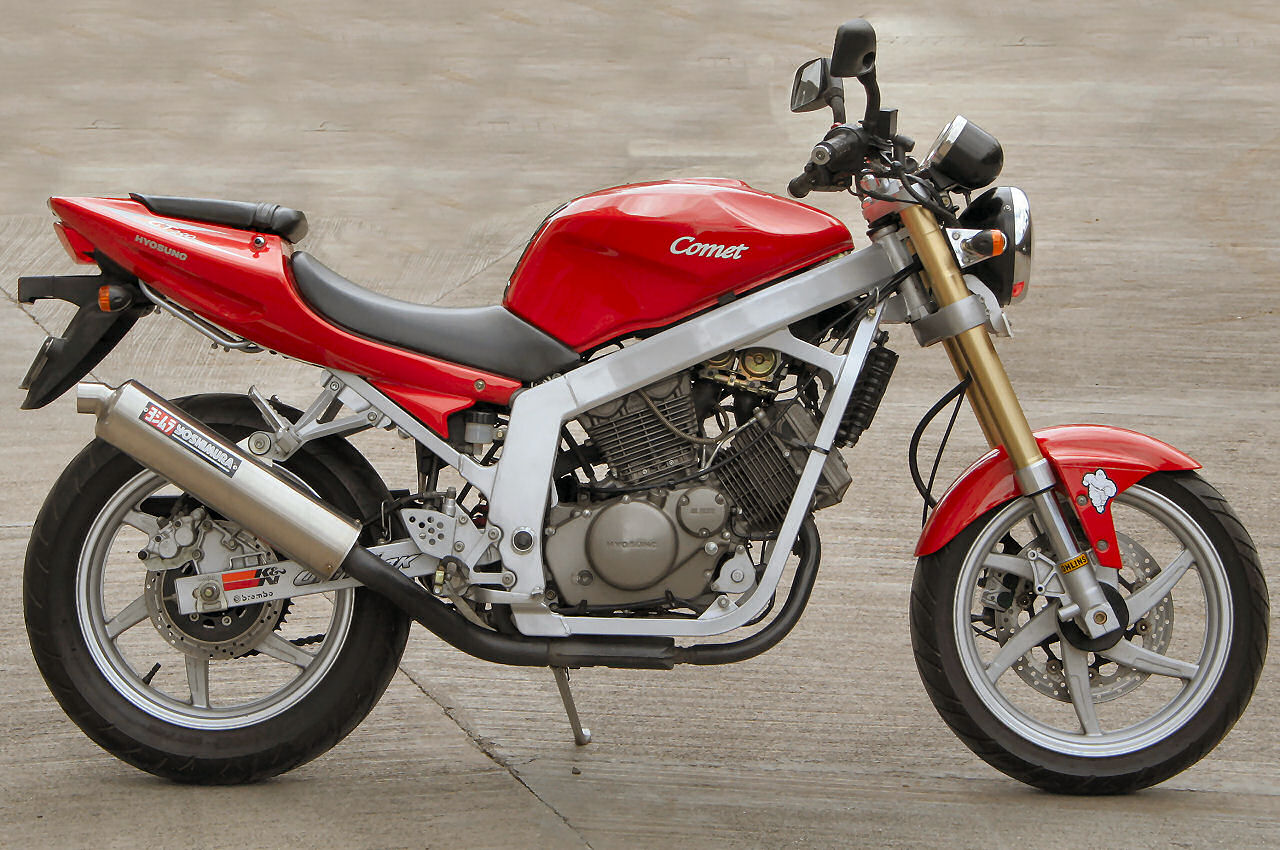
We motorcyclists like the idea of bolt-on performance. If replacing a couple of stock parts with a few easily available (and not hugely expensive) aftermarket items gives us a bit more horsepower and a few more km/h, we’re all for it. And hence, this month, my Hyosung Comet GT250 has been at the receiving end of two transplants – the stock air-filter has been replaced with a K&N unit, and the standard, super-quiet (and very heavy!) exhaust can has been replaced with a much lighter, free-flow, stainless steel aftermarket can. And while I agree it’s morally reprehensible, the very restrictive catalytic converter has also been assigned to the dustbin. The shock has been cranked up to max preload setting in order to put a bit more weight on the front wheel and to make it steer a bit more quickly. It works!

We haven’t yet had a chance to pit the bike against our V-Box test equipment, but what I can tell you at this time is that with the K&N filter fitted, the bike definitely does feel like it’s breathing more easily, and the engine is revving more freely now. Fitting the filter took a fair amount of work – fiddling, drilling and fettling – but it’s finally working perfectly now. We haven’t re-jetted the bike yet, but once I log a few hundred kilometers, we’ll see if that’s needed.

With the new free-flow exhaust can, the Comet finally sounds like a proper V-twin motorcycle rather than an electric sewing machine. With the cat-con dumped, and this free-flow system in place, the bike is revving all the way to redline and easily going up to an indicated 145km/h. It’s also noticeably more responsive at lower rpm, and an earlier low-rev flatspot seems to have been eliminated completely. Perfect! Now all that remains is to pit the bike against our V-Box and see how it fares against a stock bike...
Related Posts Plugin for WordPress, Blogger...